
I wasn’t sure if it was the heat, the dust or the failing air conditioning of our steaming Kandahar office in Afghanistan that impeded meaningful exchanges, but even after 30 minutes of trying to get our otherwise very competent office director to outline the strategic priorities for the next few months, I was none the wiser. It was 2009 and the bloody armed conflict in the southern Afghan city had long become the biggest news story in the world.
As the incoming head of communications, I was eager to articulate a strategy positioning the organisation as a neutral, independent and strictly humanitarian actor (and therefore not worthy of being attacked by trigger-happy gunmen).
This was not my first time in a war zone, and I knew that when senior management is busy fighting fires, long-term strategic communications suffer. Our Afghanistan operation was a case in point. The modus operandi consisted of making personal connections with local decision-makers (read: armed strongmen), negotiating access, and delivering aid. Communications, when remembered at all, was an afterthought—a press release announcing that another 800 kgs of rice had found happy takers.
And yet, two global developments raised hopes that the sector would be forced to adopt a more strategic approach to its communications. First, the 2008 financial crisis hit the nonprofit world, turning competition for dwindling funds fierce. Organisations suddenly needed to communicate their value more effectively. Second, the social media revolution was empowering beneficiaries of aid to watch, evaluate, and comment on our performance in real-time.
For a moment, change felt possible. This new pressure meant communications staff occasionally began winning age-old internal turf wars with legal and policy teams, stripping public statements of jargon in favour of language that donors, our boards, and the public could understand.
But that optimism was fleeting. A decade on, any hope for a sector-wide awakening had evaporated, replaced by the familiar weight of short-term tactics. The sector had turned inward once more, seemingly unfazed by the growing polarisation and roiling culture wars it was uniquely positioned to address.
The moment this became painfully clear to me wasn't in a dusty field office, but in a polished headquarters. I had just taken a role leading communications for a global nonprofit when the new Executive Director called me into his office. He had two directives for my team.
First, that our newsletter images be changed to primarily reflect his target audience—the board, our members, and donors—rather than the populations we aimed to serve or the taxpayers funding much of our work.
Second, that we replace the clear, accessible language on our website with more technical jargon designed to appeal not to the public, but to the handful of experts and insiders in our narrow orbit.
I remember the feeling in that room—a quiet dissonance. In Kandahar, one could argue that in a war zone, long-term strategy would suffer under the weight of daily requirements. But in a polished Geneva office? There was no excuse not to take the strategically sound route. These directives confirmed that the failure wasn't circumstantial; it was systemic. They revealed who the organisation felt most accountable to: not the people we were meant to serve, nor the taxpayers funding our work.
This is the heart of the legitimacy crisis. Too many nonprofits treat their communications teams not as strategic partners in shaping a global narrative, but as technical service providers for internal power centres. How many newsletters have become long and unwieldy, not to engage the public, but to function as a CEO's progress report to their board?
Each time this happens, the real mission suffers. While we are busy catering to an internal audience, a compelling global narrative—one that conveys the urgent benefit of fighting disease or delivering aid—goes untold.
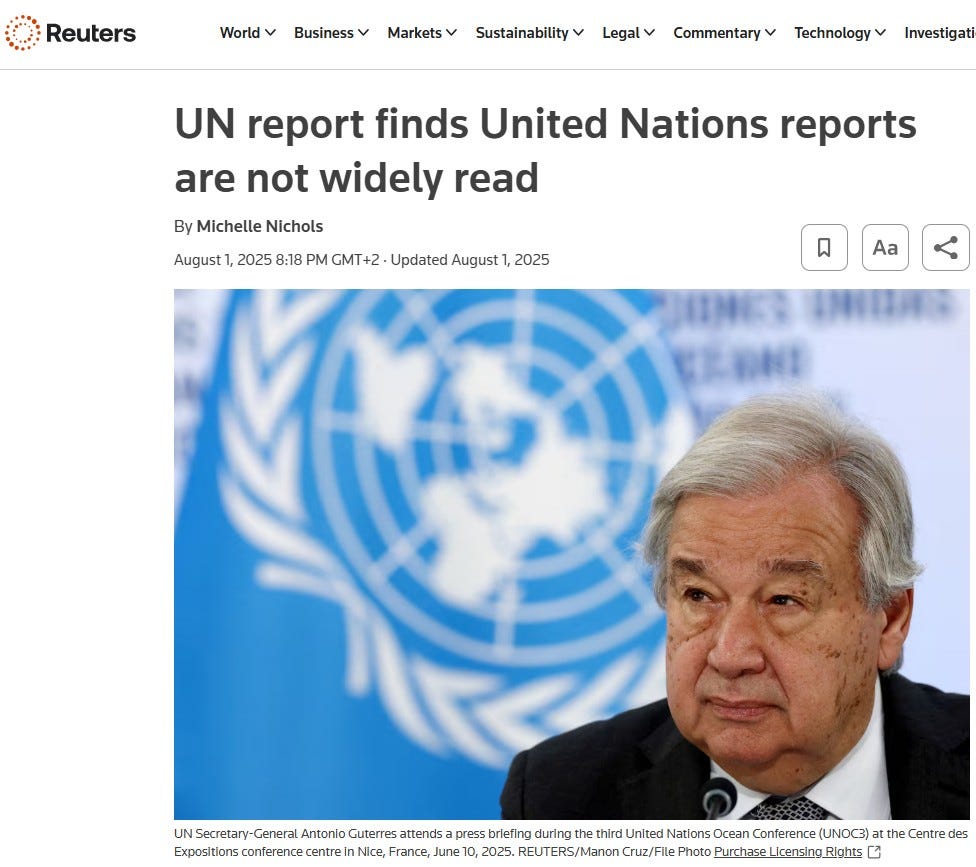
A sector truly committed to its mission wouldn't be known by a constellation of unwieldy acronyms and muddled brand identities. It wouldn’t invest precious resources into publishing reports that, as a UN report ironically confirmed to Reuters this week, are often ignored a minute after their launch.
Ultimately, the sector faces the same choice I saw in that steaming Kandahar office. It can remain a siloed ecosystem, trapped in a room of its own making, speaking only to itself. Or it can choose to become accountable to the global audiences it serves and who ultimately fund it. It can develop the ambition to step outside, into the heat and the dust, and position itself to the world as essential for a future worth living in.
I can't but wonder what "polished headquarters" that were...